Cats have a well-known weakness for boxes. There’s even research suggesting they find enclosed spaces calming, and any cat owner can tell you the same: buy a pricey bed, watch her sit in the delivery box. I’m a dog person, but when my sister’s tabby, Pudding, stayed with me, I gave in. I built her a cardboard cat house DIY style, and she moved in within ten minutes. Here are fourteen ideas, from a five-minute hideout to a full cardboard palace, plus the safety rules I’d follow.
Why Cardboard Works So Well
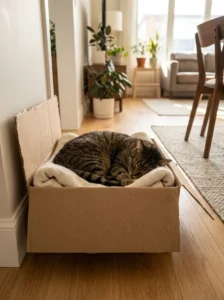
It’s free, it’s easy to cut, and cats love the texture. Some cats seem happier with a cozy hideout, since it gives them a safe place to retreat. Cardboard also insulates a little, so it feels warm.
It isn’t forever, though. Cardboard soaks up damp and wears out, so plan on replacing it every few weeks. Treat it as a testing ground. See what your cat likes, then upgrade to something sturdier if she’s a fan.
If your cat hides all the time or suddenly changes her habits, ask your vet. A box is a comfort, not a cure.
14 Cardboard Cat House DIY Ideas
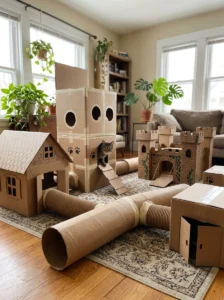
Five-minute boxes
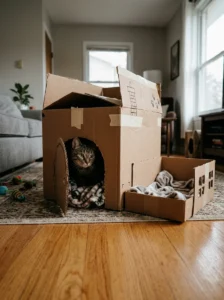
1. The Basic Hideout. Tape the flaps shut, cut a round doorway, and you’re done. Add a soft blanket inside.
2. The Open-Top Nest. Cut the top flaps off and line the box with a folded towel. Perfect for cats who like to watch.
3. The Two-Door Box. Cut a doorway in two sides, so she always has an escape route. Cats feel safer with an exit.
4. The Window Box. Cut a square window in the side, so she can peek out. Add a cardboard flap that she can push open.
Weekend projects

5. The Cardboard Castle. Stack three boxes, cut windows, and add turret tubes from kitchen roll tubes. Dramatic and very photogenic.
6. The Tunnel Maze. Join boxes with cardboard tubes to make winding tunnels. Great for playful cats.
7. The Cat Cottage. Cut a pitched roof from flat cardboard, add a door and a window. Looks like a tiny house.
8. The Scratch-and-Sleep Combo. Glue layers of corrugated cardboard inside the base. Your cat can sleep and scratch in one place.
9. The Multi-Level Condo. Stack two or three boxes, cutting holes between them. Reinforce each level so it doesn’t collapse.
10. The Hanging Pod. A small box hung from a sturdy frame with strong straps. Test the weight before she hops in.
The palace builds
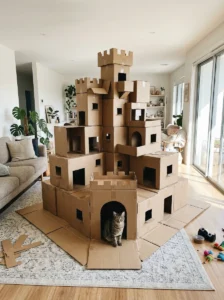
11. The Palace With Rooms. A large box divided with cardboard walls into a bedroom, a lookout, and a hideout. Takes patience.
12. The Gift Wrap House. Cover the outside in plain, non-toxic craft paper and add painted details. Use pet-safe, water-based paint, and let it dry fully.
13. The Cardboard City. Many small boxes arranged like buildings, with connecting doors. A play space as much as a home.
14. The Window-Perch Palace. A tall box tower ending in a window-level lookout. Fix the base so it can’t tip.
The Tip That Surprised Me
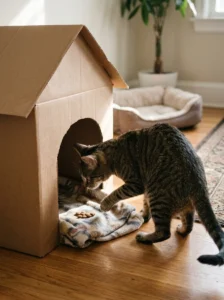
Here’s the one nobody tells you. Smell matters more than style. Pudding ignored my first box, built carefully and decorated nicely. Then I rubbed a blanket she loved on the inside, and she moved in at once.
So place the box near where she already naps, scatter a few treats inside, and let her find it herself. Picture a cat circling the box three times, sniffing every corner, then flopping in with a satisfied sigh. That’s a five-star review.
And never seal her in. Always leave at least two escape routes.
A Real Example From My Friend Priya
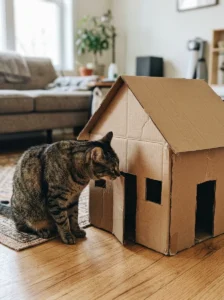
Priya built a cardboard cottage for her cat, Mochi, with a pitched roof, two doorways, and a little window. Mochi sat on top of it first. Then she tested each doorway, then she squeezed inside. By evening she was asleep in it.
Priya’s total spend was zero. Her total time was one wet Sunday afternoon. “I’d bought a cat cave for thirty dollars,” she told me. “She hates it.”
Mistakes and Warnings Worth Knowing
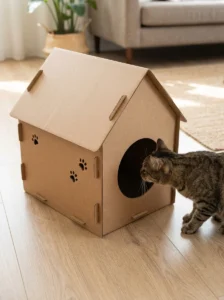
Remove staples, tape, and loose labels. Cats chew, and swallowed bits can cause serious trouble. Use only a thin strip of tape on the outside, and cover rough edges.
Skip toxic glue and paint. Use non-toxic, pet-safe options and let everything dry and air out before your cat goes near it.
Don’t use boxes that held strong chemicals or scented products. Cats can be sensitive to smells. Choose clean, plain boxes.
Check the doorway size. It should be big enough for her to move comfortably, without squeezing.
Replace damp or chewed cardboard right away. Soggy boxes collapse, and swallowed chunks aren’t safe. If your cat swallows cardboard, seems unwell, or stops eating, call your vet straight away.
Keep dogs away from the build. Even gentle dogs can crush a cardboard house in seconds.
Quick Questions
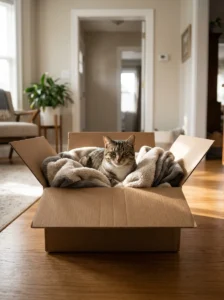
Why do cats love boxes?
Nobody knows exactly. Many owners believe it’s the snug fit and the feeling of safety.
How long will it last?
A few weeks, usually. Replace it when it sags, tears, or gets dirty.
Should I cover it with fabric?
A removable blanket inside is fine. Skip loose threads and anything glued on.
Ready to Build Your Cardboard Cat House DIY?
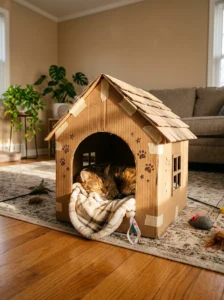
You don’t need all fourteen. Grab a box, cut a doorway, and see what your cat does. The best cardboard cat house DIY ideas are simple, safe, and built around what your cat already enjoys. Start small, rub it with a familiar scent, and let her take it from there.
Got a dog in the house, too? Have a look at my post on cozy dog beds that don’t wreck your living room. And tell me: does your cat prefer the box or the expensive bed?