In the wild, an animal showing obvious signs of weakness becomes a target for predators or loses status within a pack. Domestic dogs still carry that instinct, even though it no longer serves any survival purpose in a home environment — which is exactly why subtle behavioral changes, not dramatic symptoms, are often the only signs an owner gets.
Movement and Posture

Changes in posture or gait. A hesitation before jumping, stiffness getting up from lying down, or an altered gait that wasn’t there before. Dogs in pain often shift their weight away from the affected area, which can look like limping, a hunched back, or an unusually low head carriage.
Reduced activity or reluctance to exercise. A dog who suddenly doesn’t want the usual walk, hesitates on stairs, or tires much faster than normal may be dealing with discomfort, particularly joint or muscle pain. Worth watching closely in older dogs, since it’s easy to write off as “just getting older” when it’s actually treatable.
Changes in posture while resting. Some dogs in pain adopt a hunched or “prayer” position (front legs and chest lowered, rear end raised) that can indicate abdominal discomfort. Others struggle to get comfortable, repeatedly shifting positions while lying down.
I learned to watch for these the hard way with Mishi a couple of years ago. She’d been slightly less enthusiastic about her evening walks for a week or two, but she was still eating normally, still wagging her tail, still seemed “fine” on the surface. It wasn’t until I noticed she was hesitating before jumping onto the couch — something she used to do without a second thought — that it clicked: she was in pain, and had probably been for longer than I realized.
Eating, Drinking, and Bathroom Habits
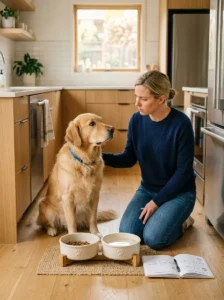
Changes in appetite. Pain — especially dental pain or abdominal discomfort — can cause a dog to eat less, eat more slowly, or show reluctance toward certain textures of food. If your dog suddenly turns away from a meal they normally love, pay attention.
Changes in bathroom habits. Straining, whining, or hesitating during urination or defecation can indicate pain and shouldn’t be dismissed as a one-off. This can point to anything from a urinary issue to joint pain that makes the position uncomfortable — squatting itself can be genuinely painful for a dog with hip or knee problems, which is easy to overlook if you’re only watching for limping while walking.
A Detail Most Owners Miss: Eyes and Facial Tension
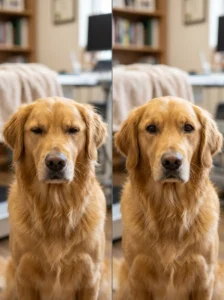
Beyond the more obvious behavioral signs, facial expression carries real information too, similar to how vets and researchers now use grimace scales for assessing pain in various species. Watch for tension around the eyes (sometimes a slightly squinted or “worried” look), ears held differently than normal, or a generally tighter, less relaxed facial expression compared to your dog’s typical resting face. This is subtle and takes some practice to notice reliably, but once you’ve built familiarity with your own dog’s normal relaxed expression, deviations become more apparent.
Behavior and Mood
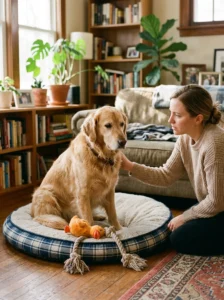
Withdrawal or hiding. A dog who suddenly wants to be alone, retreats to a quiet corner, or avoids interaction they’d normally welcome may be in discomfort. Bruno does this occasionally — he’ll go lie under the dining table by himself instead of his usual spot next to me on the couch.
Increased aggression or irritability. A normally easygoing dog who suddenly snaps, growls when touched in a specific area, or seems unusually irritable could be signaling pain rather than a behavior problem. This distinction matters — punishing the behavior without investigating the cause can make things worse and damage trust.
Excessive sleeping or lethargy beyond normal tiredness. There’s a difference between a dog who’s had a long day and is naturally tired, versus one who seems unusually low-energy across multiple days. The second pattern is worth discussing with your vet.
The Signs Most Easily Mistaken for Something Else
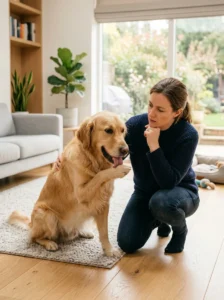
Excessive licking or grooming of a specific area. Dogs often lick or chew at a painful spot repeatedly, sometimes to the point of creating a sore (often called a “hot spot”). This one is easy to dismiss as a behavioral quirk rather than a pain response.
Panting without an obvious reason. Panting that happens when your dog isn’t hot, hasn’t been exercising, and isn’t anxious can signal pain. It’s subtle because panting has so many normal explanations, which makes context everything.
Changes in vocalization. Whining, yelping when touched or moved a certain way, or unusual groaning can all indicate pain, especially if it’s new behavior.
Shaking or trembling. Trembling has many possible causes (cold, anxiety, excitement), but unexplained shaking — particularly combined with other signs here — is worth mentioning to your vet.
(Worth saying plainly: I’m an experienced owner, not a vet — everything here is what’s helped me notice when something’s wrong, not a diagnostic tool.)
A Simple Hands-On Check I Learned From Our Vet
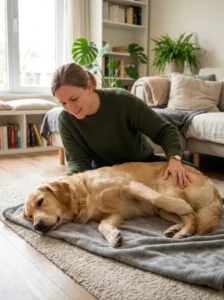
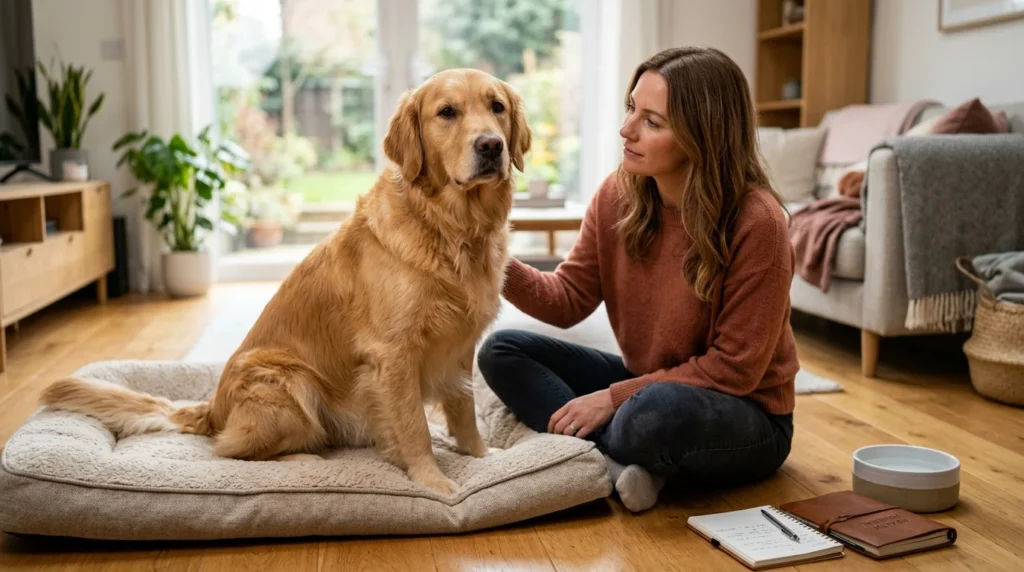
With your dog calm and relaxed, gently run your hands along their body — starting at the head and working back along the spine, then down each leg — using light, even pressure. You’re watching for a flinch, a pulled-away limb, increased tension, or vocalization at a specific spot, compared to a relaxed response everywhere else. It’s not diagnostic, and it won’t catch internal pain, but it’s useful for noticing localized sensitivity that might not be obvious from watching your dog move around normally. I do a loose version of this during regular petting now, more out of habit, and it’s caught a couple of minor issues early with both dogs over the years.
This same gentle-touch approach also works well as a way to build a baseline of what’s normal for your specific dog, which matters more than it sounds. Bruno, for instance, has always been mildly ticklish along his ribs in a way that’s just his personality, not a pain response — knowing that baseline means I don’t mistake a normal reaction for a concerning one. Mishi, by contrast, has never shown that same sensitivity, so any new reaction along her ribs would actually mean something different for her specifically than the identical reaction would mean for Bruno.
Acute vs. Chronic Pain
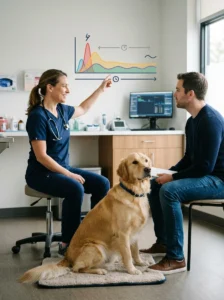
It’s useful to separate pain into two broad categories, since they present differently and call for different responses. Acute pain comes on suddenly, often tied to an obvious cause like an injury, and produces dramatic, easier-to-spot signals — yelping, sudden limping, visible distress. This generally warrants prompt attention since it indicates something specific and recent.
Chronic pain develops gradually, often over weeks or months, and is exactly the type that’s hardest to catch because it has no single dramatic moment attached. This was Mishi’s situation — a slow accumulation of small behavioral shifts rather than one obvious event. Chronic pain is also, frustratingly, the type owners are most likely to misattribute to “just getting older” or “just being lazy today,” when it’s often treatable.
How Pain Shows Up Differently Across Life Stages

Pain doesn’t present identically across a dog’s life. Puppies experiencing pain often show it through unusual quietness or reluctance to play, easy to mistake for simple tiredness. Adult dogs in their prime tend to mask pain most effectively, often maintaining near-normal behavior until discomfort becomes significant. Senior dogs frequently show more gradual, easy-to-dismiss signs, since slowing down is also a normal part of aging — which is exactly why distinguishing “normal aging” from “treatable pain” matters, and why gradual changes are worth raising at routine vet visits rather than assumed expected.
When It’s an Emergency, Not a Watch-and-Wait
Some signs warrant an immediate vet visit:
⦁ Sudden, severe limping or inability to bear weight on a leg
⦁ Visible swelling, especially of the abdomen
⦁ Crying out when touched in a specific area
⦁ Collapse or extreme lethargy
⦁ Pain combined with vomiting, diarrhea, or refusal to drink water
⦁ Any suspected injury from a fall, car accident, or fight with another animal
What I Actually Do When I Suspect Pain
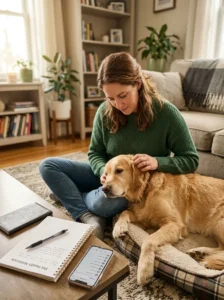
1. I watch for a day or two, tracking specific behaviors rather than relying on a vague feeling that something’s off. Is it consistent? Getting worse? Tied to a specific movement or activity?
2. I gently check for an obvious cause — a thorn in a paw, a visible injury, swelling, or sensitivity when I touch certain areas — without forcing anything that seems to cause distress.
3. I call the vet rather than guessing at the cause myself. Pain can stem from so many different sources — dental issues, joint problems, internal discomfort, an injury — that a proper evaluation is really the only way to know for sure.
4. I never give human pain medication. This is critical: many common human pain relievers, including ibuprofen and acetaminophen, are toxic to dogs even in small amounts. Pain management should always come from your vet.
A few quick answers to things people ask me often: yes, dogs can hide pain even from owners who know them well — it’s instinct, not choice, which is part of why regular checkups matter. Limping should always be taken seriously, even if minor, since it means your dog is avoiding weight on a limb for a reason. A slower older dog isn’t automatically “just aging” — it’s worth mentioning at the next visit rather than assumed. And if you suspect pain at home, the safest move is to keep your dog calm, limit activity, and get them evaluated — comfort and rest are safe, guessing at treatment is not.
One thing that’s taken time to develop is genuine confidence in trusting subtle observations, even without dramatic evidence. Early on with Mishi, I second-guessed myself — was she really moving differently, or was I imagining it? Looking back, I wish I’d brought it up sooner rather than waiting for more obvious confirmation. My current approach: if something feels different, even if I can’t fully articulate why, I mention it at the next vet visit rather than waiting for it to become unmistakable. Vets are generally glad to investigate based on an owner’s gut sense — that instinct, built from actually knowing your dog’s normal patterns, is valuable information on its own.
Learning to read Mishi’s subtle signs changed how I pay attention to both dogs day to day. It’s not about becoming anxious over every small change — it’s about noticing patterns and trusting that instinct when something genuinely feels different. Dogs can’t tell us in words when something hurts, but if you’re paying attention, they’re telling us anyway.
Related reading: joint health and preventing arthritis early and senior dog care.