
I’ll admit I didn’t think much about joint health until I started noticing small changes in how Mishi moved — a slight hesitation before jumping onto the couch, a bit more stiffness getting up after a nap. None of it was dramatic, but it got me curious about what we could be doing proactively, rather than just reacting once stiffness became more obvious.
What I learned changed how I think about both of my dogs’ daily routines, not just Mishi’s. Joint health isn’t only a senior-dog issue — the habits that protect joints long-term often start much earlier. Arthritis and joint issues in dogs often develop gradually, sometimes over years, before becoming obviously noticeable. By the time visible stiffness or reluctance to move shows up, some degree of joint wear has typically already occurred. This is exactly why preventive habits — started earlier rather than later — can make a meaningful difference in how a dog’s joints hold up over their lifetime. This doesn’t mean every dog will develop joint problems, but several factors genuinely influence the odds, and many of them are within an owner’s control. (Quick disclaimer: I’m an experienced dog owner, not a vet. This guide covers general preventive habits — if your dog is already showing signs of joint pain or stiffness, a vet evaluation is the right next step before starting any new supplement or exercise routine.)
Maintaining a Healthy Weight

This is consistently the single most impactful thing an owner can control directly. Extra weight places significant additional stress on joints, accelerating wear over time, particularly in larger breeds or dogs already predisposed to joint issues.
Our weight chart guide covers how to assess whether your dog is at a healthy weight, and our feeding chart guide covers appropriate portion sizes. Keeping both dogs at a lean, healthy weight has been one of the more concrete things I can point to as actually within my control here.
Appropriate, Consistent Exercise

This might seem counterintuitive — wouldn’t less activity protect joints? Actually, the opposite tends to be true. Moderate, consistent exercise helps maintain muscle mass around joints (which provides support and stability) and keeps joints mobile, while both excessive high-impact activity and a sedentary lifestyle can each contribute to joint problems in different ways.
What’s worked for us:
⦁ Regular, moderate walks rather than infrequent intense bursts of activity
⦁ Swimming, when accessible, as a low-impact option that builds muscle without joint stress
⦁ Avoiding repetitive high-impact activities (like excessive jumping or hard stops during fetch) especially for dogs already showing any signs of joint sensitivity
⦁ Adjusting activity level gradually as a dog ages, rather than abruptly stopping exercise altogether, which can actually accelerate muscle loss and joint stiffness
The Role of Muscle Mass in Joint Support
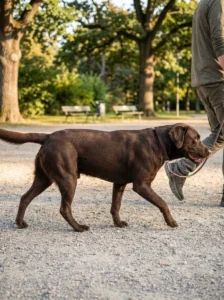
Something our vet emphasized that I hadn’t fully appreciated before is how directly muscle mass around a joint contributes to that joint’s stability and function. Strong surrounding muscle essentially acts as a support system, absorbing some of the stress that would otherwise fall directly on the joint structures themselves. This is part of why maintaining appropriate exercise — rather than reducing activity out of caution once early stiffness appears — is generally still recommended, just adapted to lower-impact forms.
For Mishi, this meant our vet recommended continuing regular movement, just shifted toward gentler activities like consistent leash walks and, when accessible, swimming, rather than scaling back activity dramatically the moment we noticed her early stiffness. Maintaining her muscle tone has seemed to genuinely support her overall mobility and comfort, compared to what I suspect would have happened if we’d simply let her become more sedentary out of an overly cautious instinct.
Nutrition’s Role in Joint Health

Diet plays a meaningful supporting role, beyond just weight management:
Joint-supportive nutrients, including omega-3 fatty acids, which have some evidence supporting anti-inflammatory benefits relevant to joint health. Discussing appropriate dietary sources or supplementation with your vet is worthwhile rather than assuming any product on a shelf provides meaningful benefit.
Age-appropriate formulas. Large-breed puppy foods, for example, are specifically formulated to support controlled growth, which can reduce developmental joint stress compared to standard puppy formulas in large or giant breed puppies.
Avoiding excessive treats and calorie overload, tying back to weight management as one of the most directly controllable factors.
Joint Supplements: What to Know
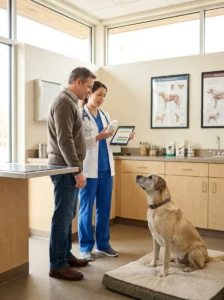
Glucosamine and chondroitin are commonly recommended joint supplements, with some research supporting their use for joint health and comfort, particularly in dogs already showing early signs of joint issues. That said, quality and dosing vary significantly between products, so it’s worth discussing specific recommendations with your vet rather than choosing based on packaging alone.
I started Mishi on a vet-recommended joint supplement once we noticed her early stiffness, and while it’s hard to know exactly how much difference any single intervention makes, her vet felt it was a reasonable, low-risk addition to our broader approach.
Supportive Home Environment
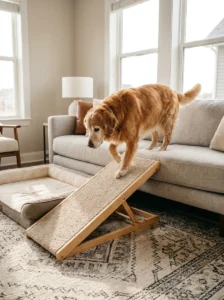
Small environmental adjustments can reduce daily joint stress, particularly for dogs showing early signs of stiffness:
⦁ Ramps or steps for getting onto furniture or into the car, reducing repetitive jumping stress
⦁ Non-slip flooring or rugs in areas where a dog walks frequently, since slipping on hard, slick floors can strain joints (and risk injury)
⦁ Orthopedic bedding, providing better support and cushioning than a thin or unsupportive bed, particularly important for dogs already experiencing some joint discomfort
⦁ Raised food and water bowls, sometimes recommended for dogs with neck or joint sensitivity, though this is worth discussing with your vet since it isn’t universally recommended for every dog
We added a small ramp for Mishi to get onto the couch more easily, which she took to almost immediately — something I wish we’d done sooner, honestly, rather than waiting until jumping became visibly harder for her.
Cold Weather, Joint Stiffness, and Practical Adjustments

While our climate doesn’t bring extreme cold, even moderate temperature drops during cooler months seem to correspond with slightly more noticeable stiffness in Mishi, something many owners of senior or joint-sensitive dogs report. A few adjustments that have helped during cooler periods: a slightly longer warm-up period before more active movement, similar to how a person might ease into activity rather than jumping straight into intense exercise; extra bedding or a heated pad (specifically designed for pet use, with proper safety features) during cooler nights; and slightly shorter, more frequent walks rather than fewer, longer ones during periods where stiffness seems more pronounced.
Recognizing Early Signs of Joint Issues

Catching changes early allows for earlier, often more effective intervention. Watch for:
⦁ Hesitation or reluctance before jumping or climbing stairs
⦁ Stiffness after rest that improves with movement
⦁ A change in gait, including limping or favoring a particular leg
⦁ Reduced enthusiasm for walks or activities your dog previously enjoyed
⦁ Difficulty getting into a comfortable resting position
⦁ Audible clicking or grinding during movement
Our guide to recognizing pain in dogs covers broader pain-recognition signs that often overlap with early joint issues.
Similar to tracking weight trends, I’ve found it useful to occasionally note specific mobility observations for Mishi — whether she’s still jumping onto the couch unassisted, how she handles a particular set of stairs, how quickly she gets up after resting. These small, specific data points, tracked occasionally over months, make it much easier to have a concrete, useful conversation with our vet about any gradual changes, rather than relying on a vague sense that “she seems a bit slower” without anything specific to point to.
Breed and Genetic Factors
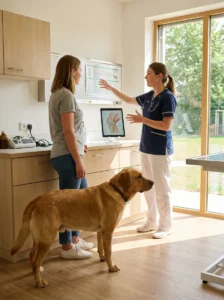
Some breeds are more predisposed to joint issues due to genetics and body structure — larger breeds, in particular, are commonly associated with higher rates of conditions like hip dysplasia. Our guide to hip dysplasia covers this specific condition in more detail. Knowing if your breed has elevated risk can help you be more proactive about preventive habits from an earlier age, rather than waiting for visible symptoms.
When to See the Vet
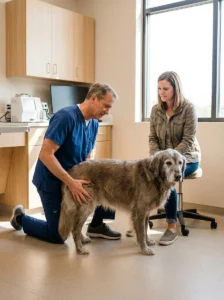
Bring up joint health proactively at routine checkups, especially for predisposed breeds or as your dog enters their senior years. Beyond routine discussion, seek a vet evaluation if you notice:
⦁ Persistent or worsening stiffness or limping
⦁ Reluctance to engage in normal activities that seems to be progressing
⦁ Visible pain or discomfort during movement
⦁ Sudden lameness or inability to bear weight, which warrants prompt attention rather than a “wait and see” approach
While this guide covers general preventive habits, it’s worth emphasizing that joint health management genuinely benefits from a personalized approach, since factors like breed predisposition, current body condition, activity history, and any existing joint issues all influence what’s actually appropriate for your specific dog. What’s worked well for Mishi’s situation might not be the right approach for a different dog with a different risk profile or activity level. Bringing up joint health proactively at routine checkups — even before any obvious symptoms appear — gives your vet the opportunity to factor it into your dog’s overall care plan from an earlier stage.
A Practical Tip: Pairing Joint Care With Existing Routines

Like several of the habits mentioned throughout this guide, joint care has stuck most successfully for us when paired with something already part of our routine, rather than treated as an entirely separate task to remember. Mishi’s joint supplement goes in with her dinner every evening, her ramp is simply always there by the couch, and her exercise pacing has just become how we naturally structure our walks now rather than something we consciously think about each time. Building preventive habits into existing routines, rather than adding entirely new standalone tasks, has made consistency genuinely achievable for us long-term.
A few quick answers: it’s worth thinking about your dog’s joint health earlier than most owners assume — preventive habits like weight management and appropriate exercise are valuable throughout a dog’s life, not just once signs of stiffness appear in their senior years. There’s reasonable evidence supporting benefits from joint supplements for some dogs, particularly those already showing early issues, though individual results vary, and it’s worth a conversation with your vet about appropriate products. Exercise is generally good for a dog with joint issues when it’s the right kind — moderate, consistent, lower-impact activity supports joint health, while both excessive high-impact activity and complete inactivity can each be problematic. And diet plays a meaningful supporting role, primarily through weight management and some evidence-backed nutrients like omega-3s, though it works best alongside other preventive habits rather than as a standalone solution.
It’s worth ending on this note: the goal of all this preventive effort isn’t to eliminate every possibility of joint issues, which genuinely isn’t fully within an owner’s control given how much genetics contributes. The goal is giving your dog the best realistic chance at comfortable, mobile years for as long as possible, and catching any issues early enough that management stays straightforward rather than complicated.
Watching Mishi’s small early signs of stiffness pushed me to actually learn about joint health instead of assuming it was simply an inevitable part of aging to deal with once it happened. The habits we’ve built since — weight management, consistent exercise, a supportive home environment — feel like genuinely worthwhile investments in both of our dogs’ comfort and mobility for years to come.
For more on supporting your dog through every life stage, our guides on senior dog care and hip dysplasia are worth reading next.