For longer than I’d like to admit, I just followed the feeding guidelines printed on the dog food bag without questioning them much. It wasn’t until our vet pointed out that Bruno was creeping toward being overweight, despite us following the bag’s recommended portion almost exactly, that I learned those generic guidelines are really just a starting point, not a precise prescription for every individual dog.
This guide covers how to actually figure out the right amount to feed your specific dog, going beyond the one-size-fits-all numbers on packaging.
(Worth noting upfront: I’m an experienced dog owner, not a veterinarian or nutritionist. This reflects general guidance for calculating appropriate portions — your vet can offer guidance tailored to your specific dog’s body condition, health status, and activity level.)
Why Bag Guidelines Are Just a Starting Point

Feeding charts on dog food packaging are based on average dogs of a given weight, but “average” doesn’t account for individual variation in metabolism, activity level, age, spay/neuter status, and overall body composition. Two dogs of the exact same weight and breed can have genuinely different calorie needs based on these individual factors.
This was exactly Bruno’s situation — he’s relatively low-energy compared to some dogs his size, and following the bag’s standard recommendation, calculated purely on his weight, was simply more than his actual activity level warranted.
General Calorie Guidelines by Weight

As a rough starting point (not a precise prescription), here’s a general framework many vets reference for adult dogs at a healthy weight and moderate activity level:
⦁ 10 lbs: roughly 200-275 calories per day
⦁ 20 lbs: roughly 325-450 calories per day
⦁ 30 lbs: roughly 425-600 calories per day
⦁ 40 lbs: roughly 525-725 calories per day
⦁ 50 lbs: roughly 600-850 calories per day
⦁ 60 lbs: roughly 700-975 calories per day
⦁ 70 lbs: roughly 800-1,100 calories per day
⦁ 80 lbs: roughly 900-1,200 calories per day
⦁ 90+ lbs: roughly 1,000-1,400+ calories per day
These ranges are intentionally broad, reflecting the real variation between individual dogs. A more active, higher-metabolism dog will fall toward the higher end; a more sedentary or lower-metabolism dog toward the lower end.
Converting Calories to Actual Food Portions
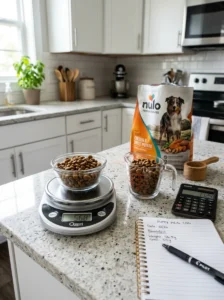
Calorie needs are the starting point, but you’ll need to translate that into an actual amount of food, which depends on your specific food’s calorie density.
Check your food’s calorie content, usually listed as calories per cup or per can on the packaging. This varies significantly between brands and formulas — some foods are notably more calorie-dense than others, which is part of why a “cup” recommendation from one brand doesn’t directly translate to another.
Calculate the actual portion by dividing your dog’s target daily calories by the calories per cup (or per unit) of your specific food, then adjusting based on how many meals you’re splitting that total across.
From my experience: When our vet flagged Bruno’s weight, we actually sat down and calculated this properly rather than continuing to estimate. It turned out we were feeding him close to 20% more than his actual calorie needs, simply because we’d been following the bag’s standard guideline without accounting for his lower activity level.
Factors That Affect How Much Your Dog Actually Needs
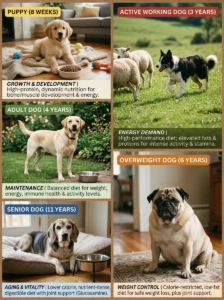
Activity level is one of the biggest factors — a working or highly active dog may need significantly more calories than a more sedentary dog of the same weight.
Age and life stage. Puppies generally need more calories relative to their body weight to support growth, while senior dogs often need somewhat fewer calories as their metabolism naturally slows.
Spay/neuter status. Spayed or neutered dogs often have somewhat lower metabolic needs than intact dogs, which is worth factoring into portion calculations if this status has recently changed.
Body condition, assessed through the hands-on check covered in our weight chart guide, is ultimately the most reliable ongoing indicator of whether your current feeding amount is appropriate — adjust portions based on actual body condition trends, not just a calculated number that never gets revisited.
Climate and season, particularly relevant in places with significant seasonal temperature swings — dogs sometimes need slightly more calories in colder weather to help maintain body temperature, and may naturally eat somewhat less during extreme heat when activity levels often drop.
Puppy Feeding: A Different Calculation

Puppies have notably different needs than adults, generally requiring more frequent meals and a higher calorie density relative to their body weight to support rapid growth.
General puppy feeding frequency:
⦁ 8-12 weeks: 4 meals per day
⦁ 3-6 months: 3 meals per day
⦁ 6-12 months: 2 meals per day, transitioning toward adult feeding schedule
Specific calorie needs for puppies vary significantly by expected adult size, with large-breed puppies needing particular attention to controlled growth rather than maximum growth, which is part of why large-breed-specific puppy formulas exist. Our puppy health checklist covers more on this early stage.
Senior Dog Feeding Adjustments

As dogs age, metabolic needs often shift, sometimes requiring fewer calories to maintain a healthy weight, even if activity level hasn’t dramatically changed. We’ve adjusted Mishi’s portions gradually as she’s settled into her senior years, working with our vet to make sure the changes track her actual body condition rather than guessing.
How to Adjust Portions Over Time
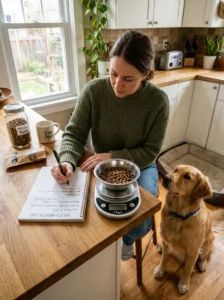
Feeding isn’t a “set it once and forget it” calculation. A practical approach:
1. Start with a reasonable estimate, based on the calorie guidelines and your specific food’s calorie density
2. Monitor body condition regularly, using the hands-on check covered in our weight guide, roughly monthly
3. Adjust gradually if you notice trending toward overweight or underweight — small portion changes (10-15%) over a few weeks, then reassess
4. Account for treats and extras in your overall calorie calculation, not just the measured meal portions, since treats can add up to a meaningful percentage of daily intake without owners realizing it
Common Feeding Mistakes
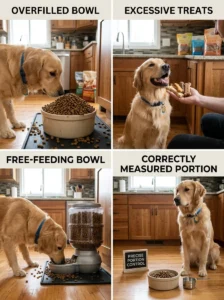
Eyeballing portions instead of measuring. A consistent measuring cup (not just an estimated scoop) makes a genuine difference in feeding accuracy over time.
Not accounting for treats in the total calorie picture. Treats given throughout the day for training or simply as extras can add up significantly if not factored into your dog’s overall daily calorie target.
Free-feeding without monitoring. Leaving food out all day, available whenever a dog wants it, makes it much harder to track actual intake and notice changes, compared to scheduled meals with measured portions.
Not adjusting after a significant life change. Spay/neuter surgery, a notable change in activity level, or aging into a new life stage are all good triggers to reassess and potentially adjust portions, rather than continuing an old routine indefinitely.
Why Measuring Cups Aren’t Always Accurate
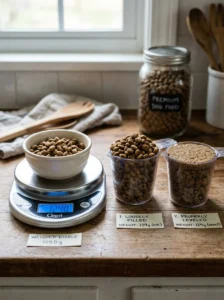
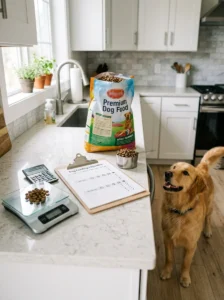
Something our vet pointed out that genuinely surprised me: the standard measuring cup most owners use isn’t always as precise as it seems, and small inconsistencies in how you scoop and level food can add up to meaningfully different actual portions over time. A loosely filled, unleveled cup can deliver noticeably more food than a properly leveled one, especially with kibble that varies in size and density between brands. For genuinely precise portion control, particularly if you’re actively managing a weight issue, a kitchen scale measuring by weight (grams or ounces) rather than volume offers more consistent accuracy than cup measurements alone, since it removes the variability introduced by how tightly or loosely food is packed into a measuring cup.
How Treats Interact With Your Calculated Portions

The calorie calculations covered in this guide focus on regular meals, but treats need to be factored into the same overall daily total, not treated as a separate, uncounted category. If you’re giving meaningful amounts of treats throughout the day — for training, for example — your regular meal portions may need slight reduction to keep total daily intake aligned with your dog’s actual calorie needs. Our guide to low-calorie treats covers this balance in more detail, but the core principle worth remembering here is that “how much should I feed my dog” really means total daily intake across everything they consume, not just the measured bowl portions.
Adjusting for Multiple Daily Walks or Variable Activity

If your dog’s activity level varies significantly day to day — an intense hiking weekend followed by several quieter days, for example — it’s worth knowing that some flexibility in daily portions, within reason, is generally fine and even appropriate, similar to how human calorie needs fluctuate with activity. This doesn’t mean recalculating portions daily, but rather understanding that the numbers in this guide represent a typical, moderate-activity baseline, with some natural flexibility for unusually active or unusually sedentary days, rather than a number that must be hit with absolute precision every single day regardless of circumstances.
What Happens When You Get the Calculation Wrong
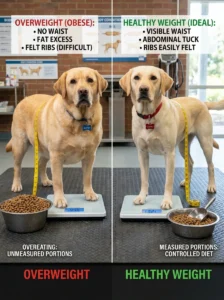
I want to offer some reassurance here too: getting your initial calculation slightly off isn’t a crisis. The body condition monitoring covered throughout this guide is specifically designed to catch and correct for an imperfect initial estimate over time. Nobody calculates their dog’s exact calorie needs perfectly on the first try — what matters is establishing a reasonable starting point and then actually paying attention to how your dog’s body condition trends over the following weeks and months, adjusting as needed rather than treating the first calculation as a permanent, unquestionable number.
Quick Reference
On the question of Should I feed my dog once or twice a day?: Most adult dogs do well with two meals a day, which tends to support more stable energy levels and digestion compared to one large meal, though your vet can advise on what’s appropriate for your specific dog. On the question of My dog always seems hungry even after eating the recommended amount — what does this mean?: This is worth discussing with your vet, since it could relate to actual calorie needs, eating speed (a dog who eats too fast might not register fullness properly), or sometimes underlying health factors worth ruling out. On the question of How do I adjust feeding for a multi-dog household with different needs?: Feed dogs separately if their calorie needs differ significantly, using individually measured portions rather than a shared bowl or estimated split, to ensure each dog actually gets an appropriate amount. On the question of Is it better to slightly underfeed or slightly overfeed if I’m unsure?: Neither is ideal, but a slight, monitored underfeeding is generally easier to correct (and carries fewer long-term health risks) than a pattern of overfeeding that leads to excess weight over time, since catching and correcting underfeeding tends to be straightforward, while reversing established excess weight requires more sustained effort.
Actually calculating Bruno’s real calorie needs, rather than continuing to follow the bag’s generic guideline, made a genuine difference once our vet flagged his creeping weight. If you haven’t recalculated your own dog’s portions in a while — especially after any life changes like aging, spaying/neutering, or a shift in activity level — it’s worth revisiting rather than assuming the original numbers still apply.
For more on related feeding topics, our guides on dog weight assessment and best feeding schedules by life stage are excellent next reads.