Bruno’s puppy house-training period gave me far more hands-on experience cleaning urine from carpet than I ever expected to need, and through plenty of trial and error, I eventually landed on an approach that actually works — not just masking the smell temporarily, but genuinely resolving both stain and odor.
Why Urine Stains Are Genuinely Trickier Than Other Spills
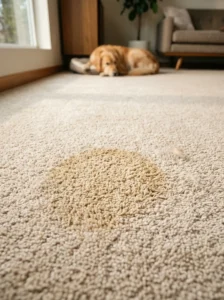
Urine, particularly once it dries, presents a specific cleaning challenge beyond simple staining. The combination of uric acid crystals (which don’t dissolve in water alone) and the way liquid penetrates deep into carpet fibers and padding means surface cleaning, however thorough it looks, often leaves both stain and odor-causing residue behind, ready to reactivate with humidity or become noticeable again over time.
Acting Quickly: Why Timing Matters
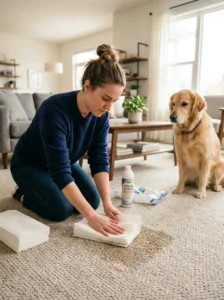
If you catch an accident immediately, your cleanup process becomes significantly easier than addressing a spot that’s already dried.
For fresh accidents:
1. Blot immediately with paper towels or a clean cloth, pressing down firmly to absorb as much liquid as possible — avoid rubbing, which pushes liquid deeper into the carpet rather than lifting it out
2. Continue blotting with fresh sections of paper towel or cloth until no more liquid transfers
3. Apply an enzymatic cleaner specifically formulated for pet urine, following the product’s instructions
For Dried, Older Stains
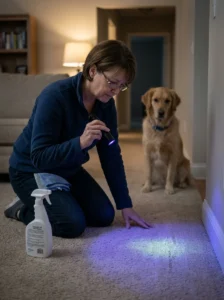
This requires a bit more work, but is still genuinely resolvable with the right approach.
1. Identify the affected area — if you’re not sure exactly where an older stain is, a UV blacklight can reveal urine stains that aren’t visible under normal lighting, which is genuinely useful for spots you suspect but can’t clearly see.
2. Saturate the area with an enzymatic cleaner, ensuring it penetrates as deeply as the original urine likely did, not just sitting on the surface.
3. Allow the cleaner to sit for the recommended dwell time on the product label, which is typically longer for dried stains than fresh ones, since the enzymes need time to break down the more concentrated, set-in residue.
4. Blot up excess cleaner after the dwell time, then allow the area to air dry completely.
5. Repeat if necessary for particularly stubborn or old stains, since deeply set residue sometimes requires more than one treatment cycle.
Why Enzymatic Cleaners Specifically Matter
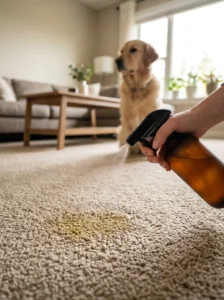
This deserves emphasis, since it’s the single most important product choice for this task. Enzymatic cleaners contain specific enzymes that break down the uric acid crystals and other organic compounds in urine, genuinely eliminating the source of both stain and odor rather than masking it. General-purpose carpet cleaners or homemade solutions without this enzymatic action often address visible staining without actually resolving the underlying odor source, which is why urine spots cleaned with general cleaners sometimes seem to “come back” with humidity or over time.
A Common Mistake: Using Steam Cleaners Too Early
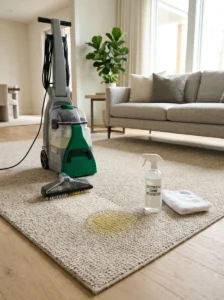
This surprised me when I learned it — using a steam cleaner on a urine stain before properly treating it with an enzymatic cleaner can actually set the stain and odor more permanently, since heat can bond the proteins in urine to carpet fibers rather than helping remove them. Always treat with an enzymatic cleaner first, allowing it to fully work and dry, before considering steam cleaning as a finishing step if needed.
Preventing Repeat Marking in the Same Spot
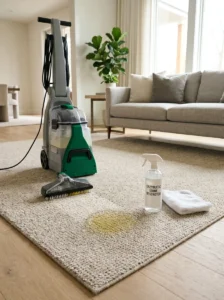
Dogs are notably prone to remarking areas where they’ve previously had an accident, particularly if the area isn’t fully cleaned of odor (even odor undetectable to humans but still perceptible to a dog’s far more sensitive nose). This is part of why thorough enzymatic cleaning matters beyond just aesthetic stain removal — it genuinely helps prevent your dog from being drawn back to the same spot repeatedly during house training, covered more broadly in our potty training guide.
What to Avoid Using on Urine Stains
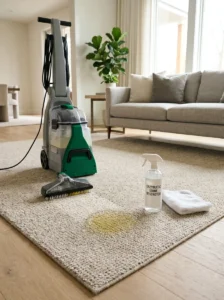
Ammonia-based cleaners — since ammonia is actually a component of urine breakdown, using an ammonia-based product can confuse a dog’s scent-based association, potentially encouraging rather than discouraging remarking the same spot.
Excessive heat before enzymatic treatment, as covered above, which can set stains rather than help remove them.
Vigorous scrubbing, which can push residue deeper into carpet padding and damage carpet fibers, rather than effectively lifting the stain out.
Dealing With Carpet Padding for Severe or Repeated Accidents
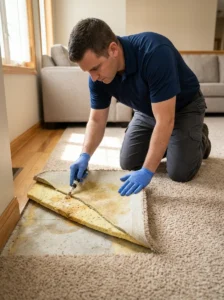
For particularly severe accidents, or repeated accidents in the same spot over time, urine can penetrate through the carpet itself into the padding underneath, where surface treatment alone won’t fully resolve the issue. In these cases, the carpet may need to be pulled back to treat the padding directly, or in severe cases, the affected padding section may need replacement — a more intensive intervention, but sometimes necessary for genuinely persistent odor that surface treatment doesn’t resolve.
Building a Quick-Response Kit for Future Accidents
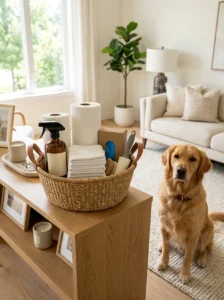
Given how much easier fresh-accident cleanup is compared to addressing dried, set-in stains, keeping a small kit readily accessible — enzymatic cleaner, paper towels, and gloves — makes responding promptly to any future accidents far more manageable than scrambling to gather supplies after the fact.
Treating Other Pet-Related Stains: Vomit and Feces
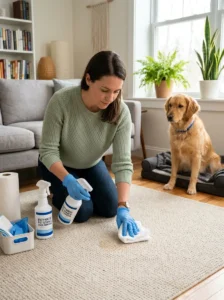
While this guide focuses specifically on urine, the same enzymatic cleaning principle applies to other organic pet-related stains — vomit and feces both benefit from the same enzymatic treatment approach rather than general cleaners, since these too contain organic compounds that enzymatic formulas are specifically designed to break down. The basic process — blot, treat with enzymatic cleaner, allow appropriate dwell time, blot again — applies similarly across these different types of organic stains, even though the specific composition differs from urine.
Protecting Carpet Proactively During Active House Training
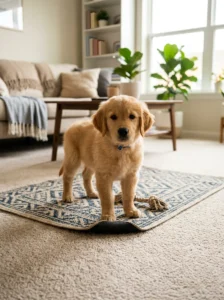
Given how much cleanup we went through during Bruno’s house training period specifically, I’d genuinely recommend proactive protection during this phase rather than purely reactive cleanup after accidents occur. Washable, waterproof rugs or mats in areas where accidents are more likely during active training, easily removed and cleaned, can save your actual carpet from repeated exposure during this higher-risk period, reducing the cumulative wear and odor-penetration risk that comes with multiple accidents in the same general area over an extended training period.
Carpet Cleaning Machines: Are They Worth the Investment?
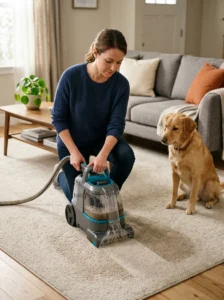
For households with ongoing pet-related cleaning needs, particularly during active house training or with a senior dog experiencing incontinence-related accidents, investing in a dedicated carpet cleaning machine for home use can be genuinely worthwhile, providing more thorough extraction than spot-cleaning with cloths and cleaner alone. This isn’t necessary for occasional accidents, but for households managing more frequent cleanup needs, the investment often pays for itself compared to the cost of repeated professional cleaning services or the cost of carpet replacement from accumulated, inadequately treated staining over time.
Senior Dogs and Incontinence-Related Cleaning Needs
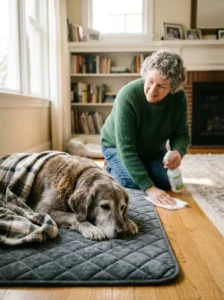
As dogs age, some develop incontinence issues unrelated to behavioral house training, sometimes related to weakening bladder control or other age-related changes, covered more broadly in our senior dog care guide. If you’re managing this kind of more frequent, medically-related accident pattern with a senior dog, the same enzymatic cleaning principles apply, though it’s also worth discussing the underlying incontinence directly with your vet, since some causes are genuinely treatable rather than something to simply manage through ongoing cleanup alone.
Cleaning Urine from Hardwood and Other Hard Flooring
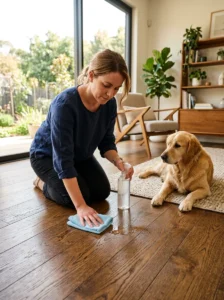
While this guide has focused primarily on carpet, urine on hardwood or other hard flooring presents its own considerations — urine can seep into seams and damage flooring finish if not addressed promptly, making quick cleanup even more time-sensitive than with carpet in some respects. Wiping up liquid immediately, then cleaning with an appropriate, flooring-safe enzymatic product, and drying thoroughly, helps prevent both odor retention and potential damage to the flooring finish itself from prolonged liquid contact.
Why Patience With the Process Matters More Than Speed
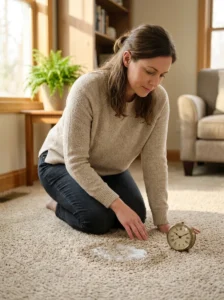
Looking back at our own puppy training period, I genuinely wish I’d understood the importance of dwell time earlier rather than rushing through cleanup to get back to other things. Allowing an enzymatic cleaner the full recommended time to actually work, even when it feels like an inconvenient delay, produces meaningfully better results than rushing the process — a lesson that took a few repeat “mystery” odor situations to fully internalize before I started consistently following proper dwell times rather than cutting the process short.
Keeping Records for Recurring Accident Patterns

If accidents seem to keep happening in similar areas or under similar circumstances despite training progress, keeping a brief record — location, timing, any pattern you notice — can help identify whether something specific is driving the recurrence, whether that’s an incompletely cleaned previous spot still attracting your dog’s attention, a training gap needing more focused attention, or in some cases, an underlying medical issue worth discussing with your vet rather than assuming it’s purely a behavioral training matter.
A few quick answers: How can I tell if old urine stains are still present if I can’t see them — A UV blacklight, used in a darkened room, will typically reveal urine stains through fluorescence even when they’re not visible under normal lighting, helping you identify and treat areas you might otherwise miss.. Will baking soda alone remove urine odor — Baking soda can help with general odor absorption as a supplementary step, but it doesn’t break down the actual urine residue the way an enzymatic cleaner does, making it a helpful addition rather than a primary solution on its own.. How long does it take for an enzymatic cleaner to fully work — This varies by product and how set-in the stain is, but most require at least several hours of dwell time, sometimes recommending overnight treatment for older or more significant stains, before the area is blotted and allowed to dry.. Is professional carpet cleaning ever necessary for urine stains — For widespread or particularly stubborn, long-standing odor that home treatment hasn’t fully resolved, professional cleaning with appropriate pet-odor-specific treatment can provide more intensive results than home methods alone..
All those puppy-training-era cleanup sessions with Bruno taught me that the right product and technique genuinely matters more than effort alone — scrubbing harder with the wrong cleaner accomplishes less than a properly applied enzymatic treatment with adequate dwell time. If you’re in the middle of house training or dealing with an unexpected accident, keeping this approach in mind will save you the frustration of stains and odor that seem to mysteriously persist despite your best cleaning efforts.
For related guidance, our guides on potty training and getting rid of dog odor in your house are excellent next reads.