
I used to choose dog food almost entirely based on the front of the bag — words like “premium,” “natural,” or an appealing picture of fresh ingredients. It wasn’t until our vet walked me through what actually matters on a label that I realized how much of that front packaging is marketing rather than meaningful nutritional information, and how much more useful the smaller print actually is.
(Worth noting upfront: I’m an experienced dog owner, not a veterinarian or veterinary nutritionist. This reflects general label-reading guidance — your vet remains the best resource for evaluating whether a specific food is appropriate for your individual dog’s needs.)
Start With the Nutritional Adequacy Statement

This is genuinely the most important piece of information on the entire label, and it’s often in small print, easy to overlook. This statement confirms whether the food has been formulated to meet established nutritional standards for a specific life stage — puppy, adult, senior, or “all life stages.”
Look for language confirming the food is “complete and balanced” and formulated to meet recognized nutritional standards, ideally through actual feeding trials rather than formulation alone (feeding trials generally provide stronger evidence of real-world adequacy than formulation calculation alone, though both are accepted approaches).
Why this matters more than front-of-bag claims: A food can have appealing marketing language without this statement actually confirming complete nutritional adequacy. This single piece of information tells you more about whether the food is genuinely appropriate as a primary diet than almost anything else on the package.
Understanding the Ingredient List

Ingredients are listed by weight, from most to least, which is useful but also slightly more complex than it first appears.
Watch for ingredient splitting. Sometimes a single ingredient type is split into multiple listings (like different forms of the same grain) to make it appear lower on the list than if it were combined as one entry, which can make a formula appear to have more meat as the “first ingredient” than the actual overall composition reflects.
Named protein sources are generally preferable to vague terms. “Chicken” or “chicken meal” is more specific and traceable than vague terms like “meat meal” or “animal byproduct,” which don’t specify the actual source.
Don’t assume length of ingredient list reflects quality. A shorter list isn’t automatically better, and a longer list isn’t automatically worse — what matters is the actual quality and appropriateness of the specific ingredients present, not the count.
Decoding Common Marketing Terms
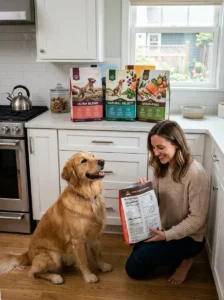
A lot of label language sounds meaningful but isn’t actually regulated in a way that guarantees nutritional superiority:
“Natural” generally means the food doesn’t contain synthetic ingredients (with some exceptions for added vitamins and minerals), but doesn’t speak to overall nutritional quality or appropriateness.
“Premium” or “Super Premium” aren’t regulated terms with a specific defined meaning, and don’t guarantee the food meets any higher standard than a non-“premium” labeled product.
“Holistic” similarly isn’t a regulated term with an established definition in pet food labeling.
“Human-grade” does have more specific regulatory meaning in some contexts, generally relating to how ingredients were sourced and processed, though it’s worth understanding this doesn’t automatically mean the food is more nutritionally appropriate for a dog than a non-human-grade product meeting full nutritional standards.
From my experience: Once I understood that “premium” wasn’t actually a guarantee of anything specific, I started paying far more attention to the nutritional adequacy statement and actual ingredient quality than to how a bag’s front cover described itself.
Understanding Guaranteed Analysis

This section lists minimum percentages of crude protein and fat, and maximum percentages of crude fiber and moisture. It’s useful for basic comparison but has real limitations worth understanding:
It doesn’t reflect ingredient quality. A food can have an impressive protein percentage from a lower-quality source, just as a food with a moderate percentage can come from high-quality, highly digestible sources.
Comparing wet and dry food directly using these numbers is misleading without converting to a dry matter basis, since wet food’s much higher moisture content significantly dilutes the percentages compared to dry food.
It’s a starting point for comparison, not a complete picture of nutritional quality or appropriateness for your specific dog.
Calorie Content and Feeding Guidelines

Look for the calorie content, usually listed as calories per cup, can, or kilogram. This is essential for accurately calculating appropriate portions for your specific dog, covered in more detail in our feeding chart guide, rather than relying purely on the bag’s generic feeding chart, which doesn’t account for your individual dog’s activity level and metabolism.
Life Stage Appropriateness

Confirm the food is formulated for your dog’s actual life stage — puppy, adult, senior, or “all life stages” (formulated to meet the more demanding nutritional needs of growth, making it technically appropriate for adults too, though not always ideal depending on the specific dog).
This matters particularly for puppies, where nutritional needs differ meaningfully from adult requirements, and for large-breed puppies specifically, where controlled growth formulas matter for developmental joint health, covered in our hip dysplasia guide.
Recognizing Red Flags

A few things worth being cautious about when evaluating a label:
Vague or absent nutritional adequacy statement. If you can’t find clear confirmation the food meets established standards for your dog’s life stage, this is worth questioning directly with the manufacturer or simply choosing a different product.
Heavy reliance on marketing language without substantive nutritional information. A label dominated by buzzwords with minimal actual nutritional detail is worth approaching skeptically.
Excessive or unclear use of vague ingredient terms without more specific identification of protein and other primary sources.
Comparing Foods Fairly

When comparing two different foods, particularly different formats like wet versus dry, converting nutritional percentages to a dry matter basis (removing the moisture variable) allows for a more accurate, apples-to-apples comparison than looking at the as-fed guaranteed analysis numbers directly. Many pet nutrition resources and some vet offices can help with this conversion if you’re trying to seriously compare specific products.
When to Involve Your Vet in This Process

While learning to read labels yourself is valuable, your vet remains an important resource, particularly if:
⦁ Your dog has a specific health condition affecting dietary needs
⦁ You’re considering a significant dietary change or specialized diet
⦁ You’re uncertain whether a specific product is appropriate despite reviewing the label carefully
⦁ Your dog shows signs of food sensitivity or intolerance that might relate to current food choice
Comparing Labels Across Different Brands Practically
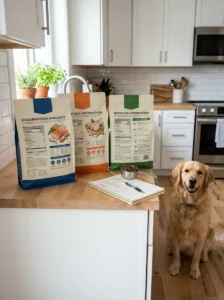
A useful exercise, once you understand the core elements covered in this guide, is directly comparing two or three specific products you’re considering, side by side, looking at the nutritional adequacy statement, named protein sources, calorie content, and overall ingredient quality together rather than evaluating each product in isolation. This comparative approach often reveals meaningful differences that aren’t obvious when looking at a single bag’s marketing in isolation, since context and comparison highlight which claims are actually distinctive versus which are standard across most reputable products in a given category.
How Manufacturing and Sourcing Information Fits Into Label Reading

Beyond the nutritional label itself, some brands provide additional information about manufacturing facilities, ingredient sourcing, and quality control practices, often through their website rather than directly on the physical packaging. While this information isn’t strictly part of “reading the label” in the narrow sense, it can provide useful additional context for owners wanting a fuller picture of a brand’s practices and transparency, particularly relevant if you’re choosing between multiple products that appear similar based on the nutritional label alone.
Why I Keep a Running Note of Products I’ve Researched

Given how much time genuinely understanding a single product’s label can take, I’ve started keeping a simple running note of foods I’ve researched and what I found, including the nutritional adequacy statement details and any concerns or questions that came up. This has saved significant time when revisiting decisions later, comparing against new products, or discussing options with our vet, rather than needing to re-research the same information from scratch each time the topic comes up.
Label Reading as an Ongoing Skill, Not a One-Time Project

I’d encourage thinking about label literacy as an ongoing skill that improves with practice, rather than something to master once and never revisit. Pet food formulations change, new products enter the market, and your own dog’s needs evolve over their lifetime — all of which mean the label-reading process described throughout this guide is something you’ll likely apply repeatedly over years of dog ownership, becoming faster and more intuitive each time, similar to how any skill improves with consistent practice.
When Label Reading Reveals You Need a Bigger Conversation

Sometimes, careful label reading raises questions that the label itself can’t fully answer — perhaps a specific ingredient sourcing question, a concern about a particular formulation choice, or uncertainty about whether a specific product genuinely suits your dog’s individual health profile. When this happens, the right next step isn’t necessarily more independent research, but reaching out directly to the manufacturer for clarification, or better yet, bringing your specific questions to your vet, who can help interpret how a given product’s profile actually applies to your dog’s particular situation in a way that general label literacy alone can’t fully resolve.
Quick Reference

On the question of Is more expensive dog food always higher quality?: Not necessarily — price can reflect marketing, packaging, and brand positioning as much as actual nutritional quality. The nutritional adequacy statement and ingredient quality matter more than price alone as quality indicators. On the question of Should I avoid all foods with byproducts listed as ingredients?: Byproducts aren’t automatically lower quality — they can include nutritionally valuable organ meats, though the term is admittedly vague and doesn’t specify exactly what’s included, which is part of why some owners prefer more specifically named ingredients when available. On the question of How often should I re-evaluate my dog’s food choice?: It’s worth a fresh look whenever your dog’s life stage changes, if you notice any signs of digestive sensitivity or other issues, or simply periodically to confirm your current choice still makes sense given any changes in available products or your dog’s needs. On the question of Can I trust online reviews more than the actual label information?: Reviews can offer useful anecdotal perspective, but they don’t replace actually understanding the nutritional adequacy statement and ingredient quality yourself, since reviews often reflect individual experience or marketing impression rather than objective nutritional assessment.
Learning to actually read past the marketing and focus on the nutritional adequacy statement and real ingredient quality changed how confidently I shop for Bruno and Mishi’s food. It’s a skill that takes a little practice, but once you know what to actually look for, it becomes a much quicker, more reliable process than relying on front-of-bag impressions alone.
For more on evaluating your dog’s diet, our guides on how much to feed your dog and grain-free dog food are excellent next reads.