Coco’s early enthusiasm for Hira’s couch armrest taught both of us that scratching isn’t a behavior problem to eliminate, but a genuine, healthy instinct to redirect — a mindset shift that made the whole process feel far less like a battle once we actually understood what was driving the behavior.
(I’m an experienced pet owner, not a veterinarian or animal behaviorist. This reflects general, widely supported guidance — for persistent scratching issues despite consistent effort, a certified cat behaviorist can offer more individualized support.)
Why Cats Scratch: Understanding the Real Instinct
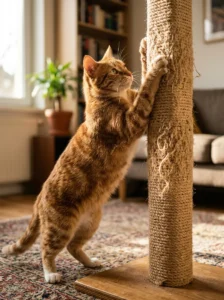
Scratching serves several genuine, important purposes for cats — it helps remove the outer layer of their claws, stretches and exercises specific muscle groups, and serves as a scent-marking behavior through glands in their paws, which is part of why cats often scratch prominently visible furniture rather than hidden areas, since the marking purpose benefits from visibility. Understanding this means the goal isn’t eliminating scratching, but redirecting it toward appropriate surfaces.
Choosing the Right Scratching Post or Surface
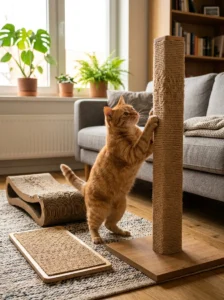
Material matters significantly. Cats show genuine individual preference for different textures — sisal rope, cardboard, certain carpeting types — and a scratching post using a material your cat doesn’t prefer often goes ignored regardless of placement or other factors.
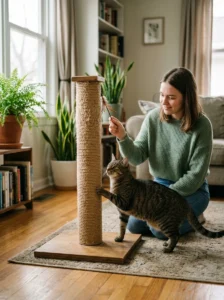
Height and stability matter for vertical scratchers. Many cats prefer scratching while fully stretched upward, meaning a tall, genuinely stable post (one that doesn’t wobble or tip during use) tends to be used more reliably than a shorter or less stable option.
Some cats prefer horizontal scratching. If your cat seems to favor scratching at floor-level surfaces like rugs, a horizontal scratching pad may better match their natural preference than a vertical post alone.
From my experience: Coco showed a clear, strong preference for sisal rope texture specifically, completely ignoring a cardboard option we’d initially tried, which reinforced for us how much individual preference genuinely matters rather than assuming any “standard” scratching post will work universally.
Strategic Placement
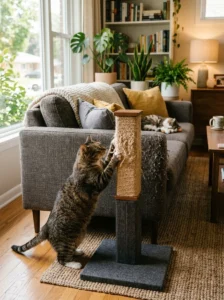
Placing scratching posts near the furniture your cat has already been scratching, at least initially, makes the appropriate alternative more immediately accessible and likely to be used, since the location itself often plays into the existing pattern your cat has already established. Gradually relocating the post to a more permanent, convenient location over time, once the habit is established, tends to work better than starting with the post in an inconvenient spot your cat has no reason to investigate.
Making Furniture Less Appealing for Scratching
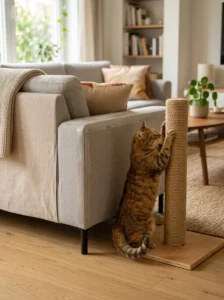
Double-sided tape on furniture surfaces creates a texture most cats actively dislike, often redirecting attention toward the more appropriate alternative nearby.
Furniture covers or protectors, at least temporarily during the redirection training period, can prevent damage while the appropriate alternative becomes established as the preferred option.
Citrus-scented deterrents, since many cats dislike citrus scent, can be applied to furniture (checking that any product used is genuinely cat-safe) as an additional deterrent layer.
Positive Reinforcement for Appropriate Scratching
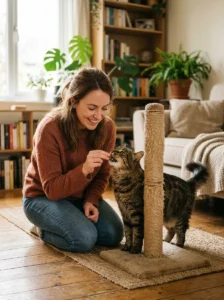
Similar to the positive reinforcement principles covered throughout our dog training guides, rewarding your cat — with treats, praise, or play — when they use the appropriate scratching post, especially during the initial redirection period, builds a stronger positive association with the desired surface.
Regular Nail Trimming as a Complementary Strategy
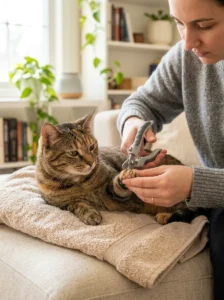
Keeping your cat’s nails appropriately trimmed, similar to the dog nail care covered in our dedicated guide, doesn’t eliminate the scratching instinct itself, but it does reduce the potential damage from any scratching that does occur on inappropriate surfaces during the redirection process.
What Not to Do
Never declaw as a solution. This procedure, beyond being considered inhumane and increasingly restricted or banned in many places, involves amputation of part of the toe, not simply nail removal, and can lead to long-term physical and behavioral complications. This isn’t a reasonable alternative to the redirection strategies covered throughout this guide.
Avoid punishment-based approaches, like spraying with water or yelling, which tend to create fear or anxiety around you specifically rather than actually teaching an appropriate alternative behavior, similar to why punishment-based approaches are discouraged in dog training too.
Why Multiple Scratching Surfaces Help
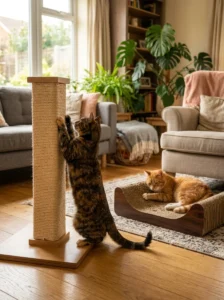
In a multi-cat household, or even with a single cat, having scratching options in more than one location — particularly near favored resting spots, since cats often want to scratch right after waking up — increases the likelihood of appropriate use compared to relying on a single post in one location.
Understanding the Scent-Marking Function More Deeply
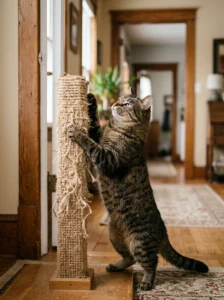
It’s worth expanding on the scent-marking purpose mentioned earlier, since understanding this helps explain some seemingly odd scratching location choices. Cats have scent glands in their paws, and scratching deposits both a visual mark and a scent signal, communicating territory to other cats. This explains why cats often choose prominent locations — doorframes, the corner of a couch facing the room’s main entry — since these spots maximize both visibility and the likelihood other cats (or in a single-cat household, simply reinforcing the cat’s own sense of territory) will encounter the mark.
Why Punishment Genuinely Backfires More With Cats Than Some Other Pets
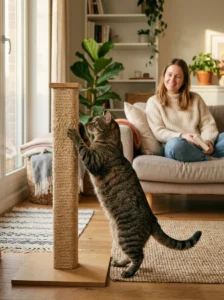
Beyond the general principle covered earlier, it’s worth being specific about why punishment is particularly counterproductive for this specific behavior with cats. Since scratching serves genuine physiological and instinctive purposes (claw maintenance, stretching, scent marking), punishing it doesn’t remove the underlying drive — it just adds fear or anxiety around the behavior, sometimes leading to a cat scratching when you’re not present specifically to avoid the punishment, rather than genuinely understanding and adopting an appropriate alternative location.
Multi-Cat Household Scratching Considerations
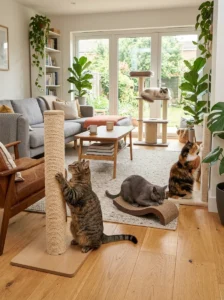
If you have multiple cats, providing multiple scratching surfaces in different locations becomes even more important than in a single-cat household, similar to the resource-availability principle covered in our multi-cat fighting guide — competition over a single scratching post can create tension, while adequate individual access reduces this friction alongside addressing the scratching behavior itself.
Replacing a Worn-Out Scratching Post
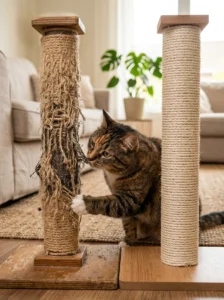
Over time, a well-used scratching post will show significant wear, and it’s worth knowing that a heavily frayed, worn post isn’t necessarily a sign to discard it immediately — many cats actually prefer a post with established wear marks, since the texture changes can become part of what makes it appealing. That said, a post that’s become structurally unstable or has lost its ability to provide resistance during scratching (an important part of the satisfying physical sensation) does need replacement to remain genuinely effective as the appropriate alternative.
Cardboard Scratchers: An Underrated, Affordable Option
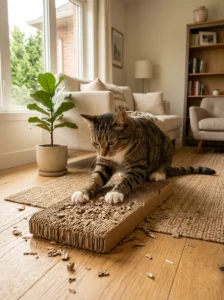
Beyond the more traditional vertical posts and horizontal pads mentioned earlier, simple cardboard scratchers deserve specific mention given how genuinely popular they are with many cats despite their low cost. The combination of texture and the satisfying way cardboard shreds during scratching appeals to many cats, and replacing these affordable scratchers regularly as they wear out is often more practical and cost-effective than relying solely on a single, more expensive post.
Why Some Cats Scratch More During Specific Times of Day
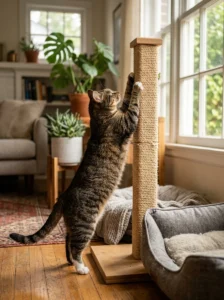
Many owners notice their cat scratching more enthusiastically right after waking from a nap or first thing in the morning, which connects to the natural stretching function of scratching covered earlier. Placing a scratching surface near your cat’s favorite resting or sleeping spot specifically takes advantage of this natural timing pattern, making the appropriate surface conveniently available exactly when the urge to scratch is often strongest.
Addressing Scratching Related to Excitement or Play
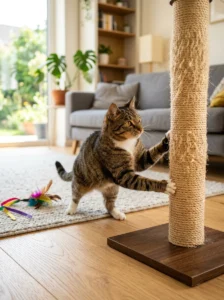
Beyond the routine, instinctive scratching covered throughout this guide, some scratching happens specifically during excited or playful moments — sometimes directed at furniture during an energetic play session rather than as a deliberate, calm act of claw maintenance. Providing a scratching surface specifically within easy reach of common play areas, not just resting areas, helps redirect this excitement-related scratching too.
What I’d Tell a Frustrated New Cat Owner
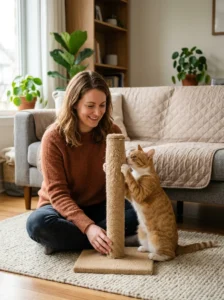
If you’re genuinely frustrated by furniture damage despite trying some of these strategies, it’s worth remembering that this redirection process, like most behavior work covered throughout our pet care guides, takes consistent application over real time, not a single quick fix. Coco’s own transition from occasionally testing furniture to reliably using her designated post took a few weeks of consistent redirection and appropriate placement before becoming a fully established habit, which is a fairly typical timeline worth expecting rather than getting discouraged by slower-than-hoped initial progress.
Combining Multiple Strategies for Faster Results
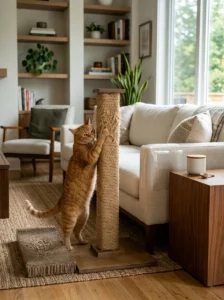
Rather than relying on a single approach, combining several strategies simultaneously — appropriate post placement, furniture deterrents, and positive reinforcement — tends to produce faster, more reliable results than implementing one strategy alone and waiting to see if it’s sufficient before adding others.
A few quick answers: Is scratching furniture a sign my cat is stressed or unhappy — Not necessarily — scratching is a normal instinct regardless of a cat’s emotional state, though significantly increased or unusual scratching patterns can sometimes correlate with stress, covered in our cat behavior guides, worth considering if the pattern seems to have shifted notably.. How long does it typically take to redirect scratching to an appropriate surface — This varies by individual cat, but consistent application of the strategies covered in this guide often shows meaningful improvement within a few weeks, particularly when started early rather than after a long-established furniture-scratching habit.. Are scratching post alternatives like soft nail caps a good solution — These can be a reasonable supplementary option for some households, temporarily covering claws to reduce damage, though they require regular reapplication and don’t address the underlying behavior the way redirecting to an appropriate surface does.. Can kittens be trained to use a scratching post from the start — Yes, and starting early, before any furniture-scratching habit has developed, generally makes the entire process considerably easier than redirecting an already-established adult behavior..
Understanding scratching as a genuine, healthy instinct rather than a behavior problem to eliminate changed how Hira and I approached helping Coco develop appropriate habits — redirecting rather than punishing, and finding the right texture and placement that actually matched her preferences. If you’re navigating this with your own cat, I’d encourage the same reframe: you’re not stopping a bad behavior, you’re redirecting a natural one toward somewhere appropriate.
For related guidance, our guides on new cat owner essentials and cat grooming basics are excellent next reads.