After years of dog potty training experience with Bruno — the schedules, the accidents, the patient repetition — watching how quickly my sister’s kitten Coco took to her litter box was genuinely a pleasant surprise. Litter training, it turns out, generally works with a cat’s natural instincts rather than against them, which makes this process considerably more straightforward for most kittens than house training a puppy.
(I’m an experienced pet owner, not a veterinarian or animal behaviorist. This reflects general, widely supported guidance — if your kitten or cat shows persistent litter box issues despite following this approach, a vet visit is worth pursuing to rule out an underlying medical cause.)
Why Litter Training Is Often Easier Than People Expect
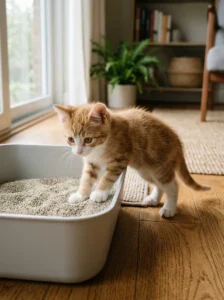
Using a covered, sand-like substrate to bury waste is largely instinctive behavior in cats, inherited from their wild ancestors who buried waste to avoid detection by predators. This means most kittens, once shown the litter box’s location, figure out the rest with minimal additional teaching required — a genuinely different process than the consistent, scheduled repetition required for puppy house training.
Setting Up the Litter Box Correctly From the Start
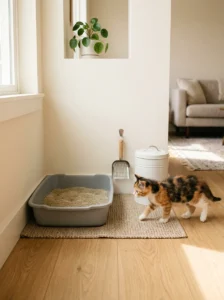
Choose an appropriate size. The box should be large enough for your kitten to comfortably turn around in, with sides low enough for easy entry, particularly important for very young kittens who may struggle with a box designed for a full-grown adult cat.
Select a suitable litter. Unscented, fine-grained clumping litter is generally well-tolerated by most cats, though some experimentation may be needed if your specific cat shows a strong preference or aversion to a particular type or texture.
Location matters significantly. Place the box somewhere quiet, accessible, and away from food, water, and high-traffic areas, since cats generally prefer privacy and a sense of security for this activity.
One box per cat, plus one extra remains the general guideline even during initial training, since access to multiple boxes reduces the likelihood of accidents due to a single box being inconveniently located or already in use.
The Basic Training Process
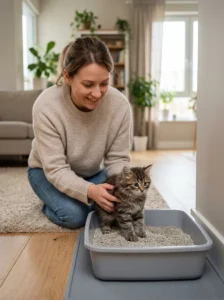
1. Show your kitten the litter box location as soon as they arrive home, placing them gently inside so they can investigate the texture and location.
2. Place your kitten in the box after key moments — waking from a nap, after eating, or after active play — when elimination is more likely to occur naturally.
3. Keep the box consistently clean. Scooping daily, and a more thorough clean periodically, encourages continued use, since cats are generally reluctant to use a heavily soiled box.
4. Avoid moving the box location once your kitten has learned where it is, at least during this initial training period, since relocating the box can cause confusion and accidents.
5. Reward calm, successful use with praise, though most cats don’t need food rewards the way dogs typically do for house training — the natural instinct itself usually drives consistent use once the location and access are established.
What to Do If Accidents Happen
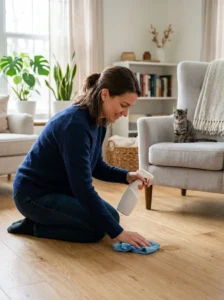
Clean thoroughly with an enzymatic cleaner, covered in more detail in our urine cleaning guide, which applies similarly to cat accidents — general cleaners can leave behind residual odor that may actually encourage repeat accidents in the same spot.
Avoid punishment. Unlike some dated dog training advice, punishing a cat for an accident is genuinely counterproductive and can create fear or stress around the litter box itself, potentially making the underlying issue worse rather than better.
Look for a pattern or cause rather than assuming the accident was random. Is the box too dirty? Is it in a location your kitten seems to avoid? Has something changed in the household that might be causing stress?
Common Reasons Litter Training Doesn’t Go Smoothly
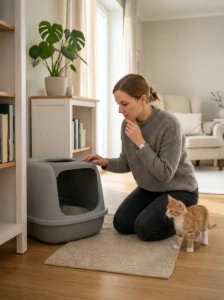
An insufficiently clean box is genuinely one of the most common causes of litter box avoidance, even in an otherwise well-trained cat.
Litter type aversion. Some cats show a clear preference or aversion to specific litter textures or scents, and switching to an unscented, finer-textured litter often resolves persistent avoidance.
Box location issues — too exposed, too noisy, too difficult to access — can all discourage consistent use.
Underlying medical issues, including urinary tract problems, which can cause a cat to associate the litter box with pain and subsequently avoid it. Persistent litter box avoidance, especially if it develops suddenly in a previously well-trained cat, genuinely warrants a vet visit to rule out this possibility before assuming it’s purely behavioral.
Litter Training Multiple Cats Simultaneously
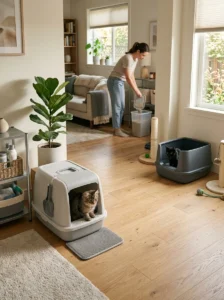
If you’re introducing more than one kitten or cat at once, providing adequate litter box access for each (following the one-per-cat-plus-one-extra guideline) becomes even more important, since competition or territorial tension around a single shared box can create avoidance issues that wouldn’t occur with adequate individual access.
Transitioning From Kitten-Specific to Standard Litter Box Setup
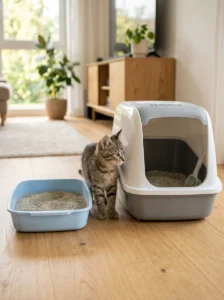
As kittens grow, transitioning from a very low-sided kitten-appropriate box to a standard adult litter box, and potentially adjusting litter type as their preferences become clearer, is a normal part of this process, generally requiring minimal additional retraining if done gradually rather than as an abrupt change.
Litter Box Cleaning Frequency and Why It Matters So Much
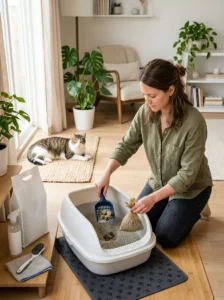
Beyond the general cleanliness principle mentioned earlier, it’s worth being specific about frequency, since this is genuinely one of the most common reasons litter training falters or regresses. Daily scooping, at minimum, is generally recommended, with a full litter change (washing the box itself) every one to two weeks depending on litter type and how many cats use the box. Cats have a notably more sensitive sense of smell than humans, meaning a box that seems acceptably clean to you may already feel genuinely unpleasant to your cat, prompting them to seek an alternative location.
Litter Box Size Considerations as Kittens Grow
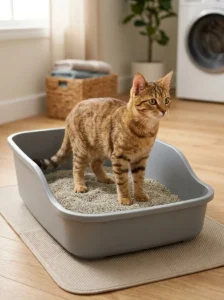
A box appropriately sized for a young kitten often becomes too small once they reach adulthood, and continuing to use an undersized box can contribute to avoidance issues that aren’t actually about training failure, but simply physical discomfort using a box that no longer fits comfortably. Planning to upgrade box size as your kitten grows, rather than assuming the original box will remain appropriate indefinitely, helps maintain consistent good litter habits through this growth transition.
The Covered vs. Uncovered Litter Box Debate
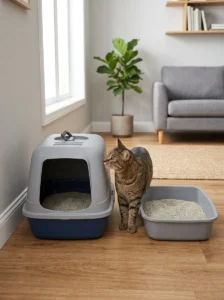
This is worth addressing directly, since opinions genuinely vary among cat owners and even professionals. Covered boxes can help with odor containment and privacy, which some cats prefer, while other cats find covered boxes confining or associate them with trapped odor that’s harder to escape, leading to avoidance. If you’re troubleshooting litter box issues, trying an uncovered alternative (or vice versa) is a reasonable experiment, similar to the litter-type experimentation covered earlier.
Litter Box Placement: Beyond Just “Quiet and Accessible”
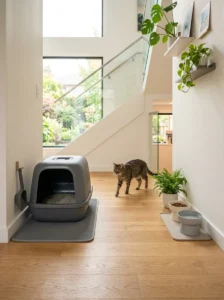
It’s worth going a bit deeper into placement considerations than the basic guidance covered earlier. Avoid placing boxes near loud appliances (washing machines, furnaces) that could startle a cat mid-use, since a frightening experience in the box can create lasting avoidance. Similarly, avoid placing boxes in a single, hard-to-reach location if you have a multi-level home — having at least one box accessible on each level reduces the chance your cat decides a closer, inappropriate spot is more convenient during an urgent moment.
What to Do When a Previously Trained Cat Suddenly Stops Using the Box
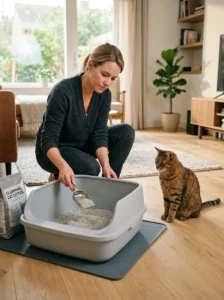
This deserves separate attention from the initial training process covered above, since it’s a genuinely different situation. A cat with previously reliable litter habits who suddenly stops using the box consistently is showing you something has changed — either in the box itself, the environment, or their health. Working through this systematically (checking cleanliness, considering recent environmental changes, and ruling out medical causes with your vet) tends to resolve the issue more effectively than simply retraining from scratch, since the underlying cause, not a training gap, is usually what’s actually driving the change.
Litter Training Cats With Mobility Limitations
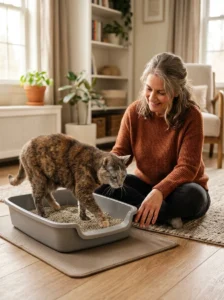
For senior cats or cats with joint issues, similar to the considerations covered in our dog joint health guide, a box with lower sides becomes important not just for kittens but also for cats who may struggle with a standard high-sided box due to age-related mobility changes. If an older cat who was previously perfectly trained suddenly starts having accidents near, but not in, the box, this is worth considering as a possible physical barrier rather than assuming it’s purely behavioral.
A Final Reassurance for Frustrated Owners
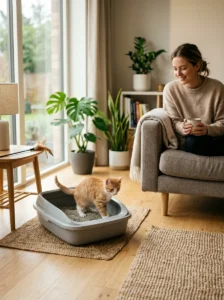
If litter training feels more frustrating than the “cats train themselves” reputation suggested, know that this genuinely does happen for some cats, and it doesn’t reflect a failure on your part. Working systematically through the troubleshooting principles covered in this guide — cleanliness, litter type, box placement, and ruling out medical causes — resolves the vast majority of cases, even when the initial instinct-driven training doesn’t go quite as smoothly as expected.
A few quick answers: How long does litter training typically take for a kitten — Many kittens show reliable litter box use within just a few days to a couple of weeks, though this can vary based on individual temperament and how consistently the setup principles covered in this guide are followed.. Is it normal for a kitten to play in the litter box rather than just using it for elimination — Yes, this is common, particularly in young kittens still exploring their environment — most kittens naturally transition to using the box appropriately as they mature, without this play behavior indicating a training problem.. Should I use litter box liners — This varies by individual cat preference — some cats are indifferent to liners, while others seem to dislike the texture or the way liners can shift during digging, sometimes leading to avoidance, so this is worth observing for your specific cat.. Can adult cats be litter trained the same way as kittens — Generally yes, the same basic principles apply, though adult cats adopted with an unknown history sometimes need a bit more patience and observation to identify any specific preferences or past negative associations affecting their litter box use..
Watching how naturally Coco took to her litter box, especially compared to the more involved process of house training a puppy, was a genuine reminder of how much working with an animal’s natural instincts simplifies training compared to teaching something that doesn’t come as naturally. If you’re starting this process with a new kitten, trust that the instinct is largely already there — your job is mostly providing the right setup and a little patience.
For more on cat care fundamentals, our guides on new cat owner essentials and best cat litter types compared are excellent next reads.